
Three technologies cool hotel minibars. Each wins on a different front: silence, consumption or power.
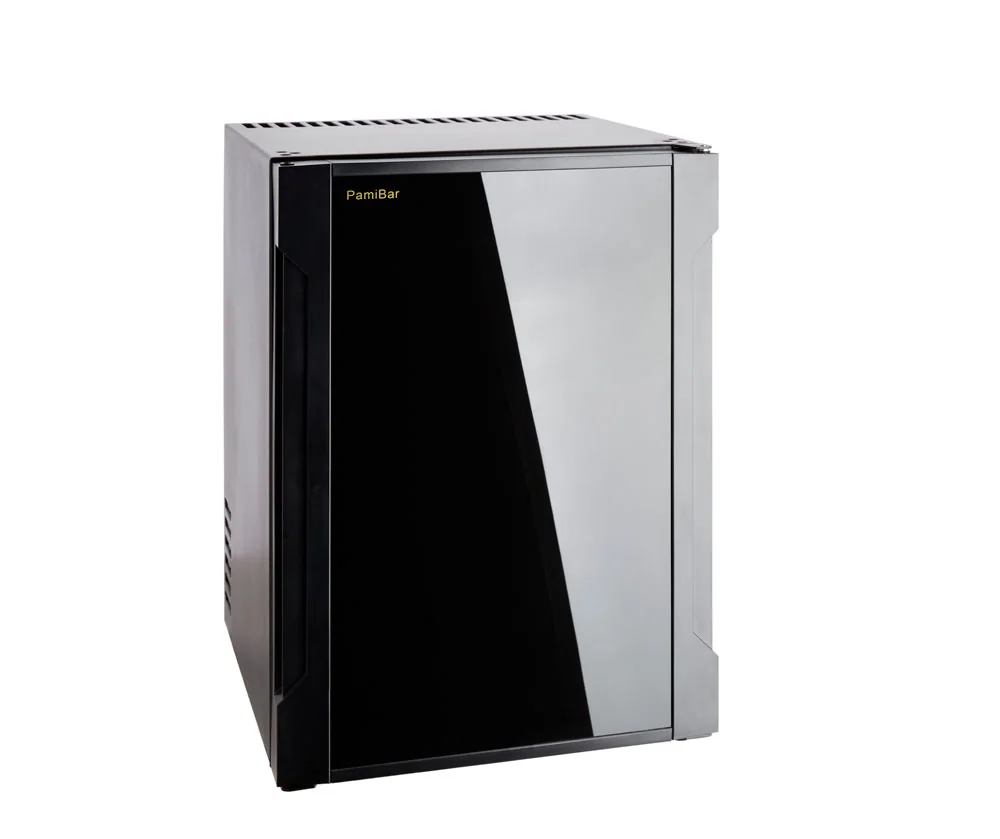
Scenario
The best technology for a hotel minibar depends on the room's priority.
Absorption is the quietest, with no compressor and no moving mechanical parts; thermoelectric Peltier combines silence with modest consumption; compressors have the best energy class and the most power, but they make noise. In documented PAMIBAR models, absorption and thermoelectric units are declared at 0 dBA.
- No compressor: no hum and no audible on-off cycles near the bed.
- No moving mechanical parts, so no vibration passed to the furniture.
- Acoustic comfort directly shapes the guest's night.
- The trade-off is higher consumption and slower cooling, to weigh against climate and service.
| Criterion | Absorption | Thermoelectric (Peltier) | Compressor |
|---|---|---|---|
| Noise | 0 dBA in documented models | 0 dBA in documented models | Audible; see technical sheet |
| Moving parts | None | No compressor | Compressor |
| Declared consumption | 0.63–1.1 kWh/24h | 0.52–0.85 kWh/24h | Class B |
| Energy class | G | F or G | B |
| Cooling power | Moderate | Moderate | High, fast recovery |
| Best for | Rooms where silence comes first | Quiet rooms with a stable climate | Warm climates and exposed rooms |
0 dBA applies to the models that declare it; do not assume it for every product using the same technology.
Technical check
- 1Standard warranty and any extension.
- 2Spare parts availability over the years.
- 3Required ventilation: every technology has to shed heat.
- 4Declared operating conditions, such as maximum ambient temperature.
Absorption, thermoelectric and compressor in the PAMIBAR range, with each model's declared data.
Declared data
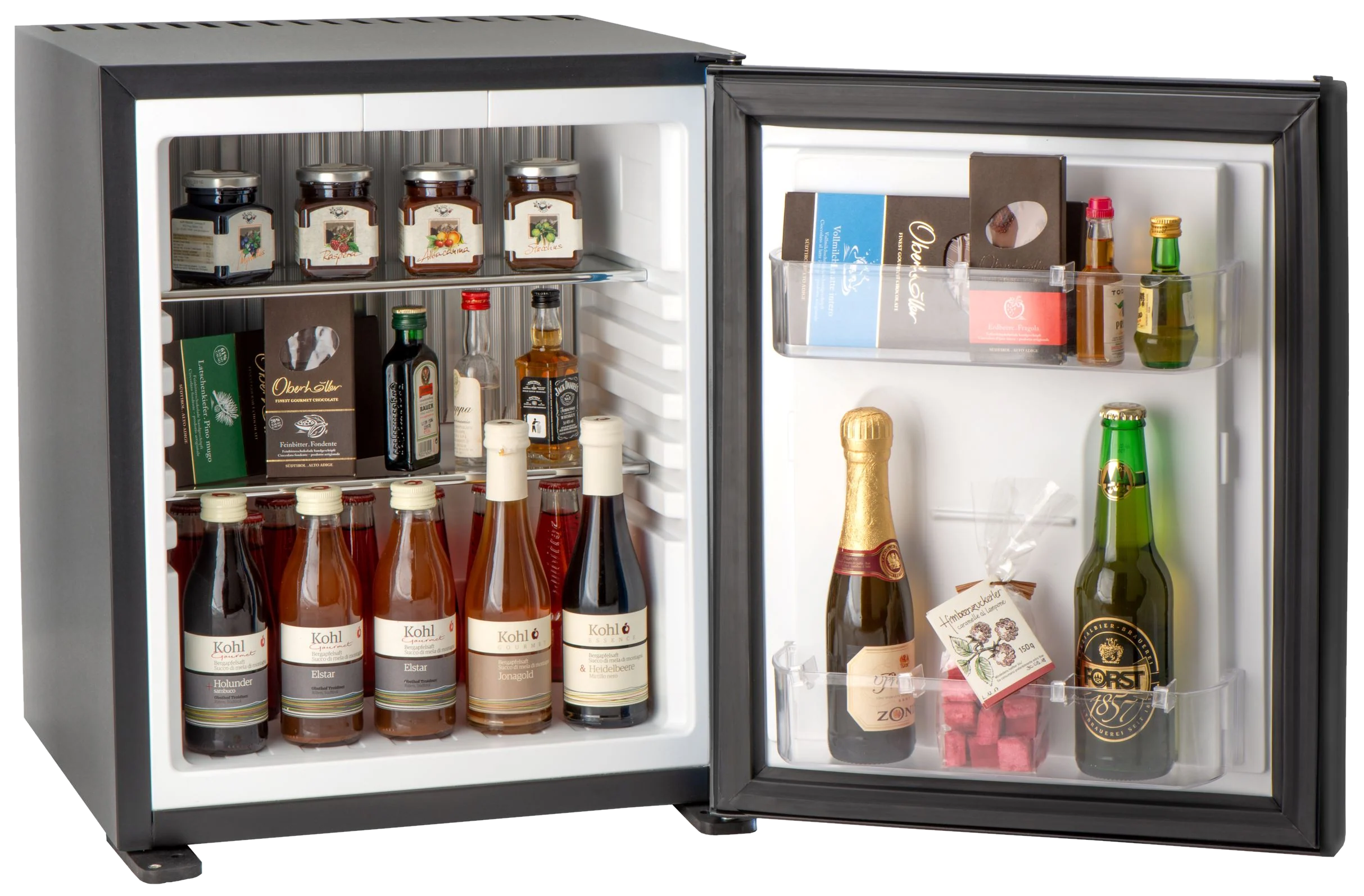
PAMIBAR SEA30
- Capacity
- 30 litres
- Dimensions
- 500 × 405 × 430 mm
- Noise
- 0 dBA
- Class · consumption
- G · 0.63 kWh/24h
Declared data
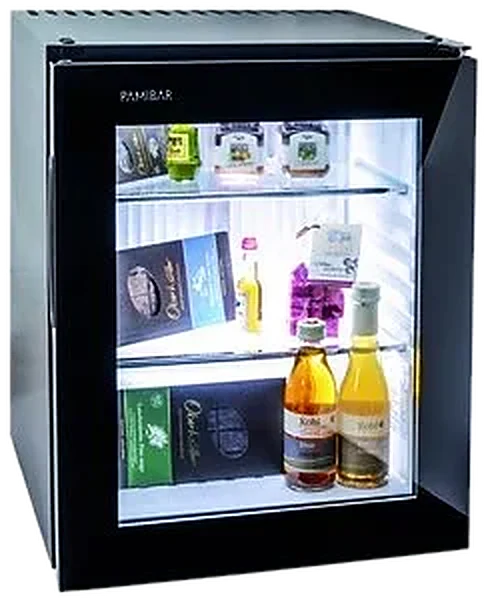
PAMIBAR SG30T
- Capacity
- 30 litres
- Dimensions
- 500 × 405 × 415 mm
- Noise
- 0 dBA
- Class · consumption
- G · 0.52 kWh/24h
Declared data
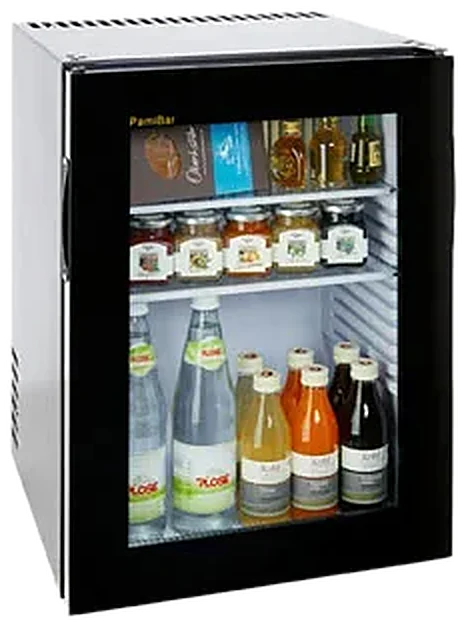
PAMIBAR SGC40
- Capacity
- 35 litres
- Dimensions
- 552 × 403 × 458 mm
Which is better for hotel rooms, an absorption or a Peltier minibar?
Both are silent: in documented PAMIBAR models, absorption and thermoelectric Peltier units are declared at 0 dBA. Peltier uses less energy (0.52–0.85 kWh/24h against 0.63–1.1 kWh/24h) and suits standard rooms that are not too warm; absorption offers more formats, from the compact 25-litre unit to the built-in drawer, and is the reference for suites and rooms where silence comes first.
Does an absorption minibar cool slowly in summer and use more than a compressor?
Yes: compared with a compressor, absorption has less power and uses more energy (class G vs B in the PAMIBAR range), and it recovers more slowly at high temperatures. In a seaside hotel, use compressors in exposed rooms and absorption where silence comes first.
Variable-speed compressor or absorption to cut energy costs?
A variable-speed compressor modulates its power and generally uses less than a fixed-speed one, but it still has moving parts. To cut costs compare declared kWh/24h; for silence near the bed absorption remains the reference choice.
What is the best cooling technology for a hotel minibar?
It depends on the room: absorption for maximum silence, thermoelectric for silence with modest consumption, compressor for power in warm climates.
Why do many hotels choose absorption minibars?
Because they work without a compressor or moving mechanical parts, so there is no compressor hum near the bed. Documented PAMIBAR absorption models are declared at 0 dBA.
Does a compressor minibar use less energy than an absorption one?
Generally yes, because compressors are more efficient. In the PAMIBAR range the SGC40 compressor model is class B, while absorption models are class G with declared consumption of 0.63 to 1.1 kWh/24h.
Peltier or compressor: which lasts longer in a hotel room?
There is no universal answer: lifespan depends mostly on ventilation, operating conditions and service. Peltier units have no compressor, compressors have moving mechanical parts; compare warranty terms and spare parts availability.